Well folks, I'm no longer a triathlon virgin.
 |
| I'm as ready as I'll ever be! |
My day started at 4am. Yeah... I was pretty tired, and fairly sure I had forgotten to pack key things when I left the house to go pick up Jesse. Half way to Issaquah, (after picking him up) he realized the
he had forgotten to pack some key things; his tools! Whoops! I wasn't too worried though.. He had tuned my bike since I returned from Hawaii, so I knew Fi was fine.
 |
| Marked. |
When Jess and I arrived at the race, it was busy and chaotic, but I found the packet pick-up, got my markings, and went to find my transition area. I was the second person the set up in my little section. The guy that got there before me was a middle-aged guy who I could tell had been doing the tri thing for a good long time. He was really nice, and actually offered a lot of helpful tips; including putting a plastic grocery bag over your hands and feet while putting your wetsuit on. (Way easier that way!)
 |
| Cold, wet, and gravely. |
After I set out my stuff (it was a sloppy mess I would come to find out), I got suited up and headed to the beach for the "briefing." Soon, I realized I had made a critical error; I had forgotten to
use the facilities before I committed my whole body to the wetsuit. Ugh. Oh well. I couldn't hear a damn thing at the briefing, so I just worked on putting on my swim cap (or caps rather; I wore my thicker one under my purple race cap - to stay warmer.)
 |
| And I'm off! |
After a bit, I asked Jess if he saw any other women in purple caps. He looks around and says, "Oh my gosh! They're in the water!" I looked and sure enough, they were just about to start my wave! I took off sprinting down the beach, and made it to the line with 30 seconds to spare! The water was not as cold as I suspected, but it was f'ing disgusting. Luckily, there were no lake weeds that I could feel until close to the end (and I pretended they were another swimmer), but the water was so murky and brown and filthy! I couldn't see a dang thing! I was second to reach the first buoy, but that's when it happened...I panicked. I couldn't see anything through my goggles underwater or above, I had gulped down a bunch of water somehow, which had me almost retching. The wetsuit was also making me feel restricted and tight in my chest, and I felt like I couldn't take a full breath. I started to think I couldn't do it...that I was going to drown, but then I snapped out of it and realized I was just scared, and that I am an excellent swimmer.
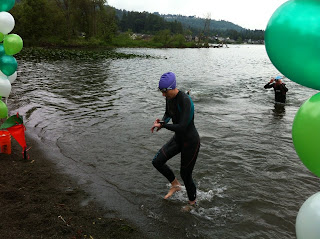 |
| I was SO happy to get out of that lake. |
When I was coming out of the water, I was fighting tears. I hadn't performed well in the water. That really disappointed me...I had hated every second of that swim; every last flippin' second. My biggest thought throughout that whole swim;
"how in the hell can I expect to do THIS for 1.2 miles?" When I saw Jesse, he was all smiles. He was so encouraging. He told me I was doing awesome. I needed to hear those words, but I was secretly thinking that he had to know how badly I had just failed. He was a Godsend truly though, in more ways than one. When I got back to the transition coral, I couldn't find my transition area! lol Luckily Jesse knew where to direct me!
 |
| All smiles on the bike, of course! |
My transition was pretty slow, but that was due to my shitty novice transition set-up. lol I remember looking up at Jesse and mouthing to him, "I don't want to do this." He said, "You're doing great babe." He is so great.
I got on my bike, and everything was almost immediately better. The ride was just plain bitchin'. I loved every moment of it. It was interesting.. I tore past a ton of men on the bike today. Of course I was passed by some too, but less than usual. There were a lot of strong women, and a lot of weaker men. Oh!..and there was one guy with panniers! WTF do you need to take with you on a 15 mile ride?? You barely need water on a ride that short!
 |
| Yay! |
My second transition was much better, but I still could have done better. The run, although I was a bit tired, was not at all unpleasant. I didn't run it fast, by any stretch of the imagination, but I ran it and I finished with a smile on my face. :)
 |
| Proud finisher. |
Incidentally, my timing chip was faulty. It did not record when I started the race. Bummer, eh? I may have some rough estimates coming though.
When I got home, I ate an apple and peanut butter, and took a 7 hour nap.
 |
| Off to enjoy my victory banana. |


